

Charles Caudrelier: No end for improvement
This skipper needs no introduction. Early in his career, he achieved success and fame in the Solitaire du Figaro and Transat Jacques Vabre races. In 2011–12, he was part of the French Groupama team that won the Volvo Ocean Race. In the 2014–15 VOR season, he became captain of the Chinese Dongfeng Race Team and led it to the podium. In the current round-the-world race, he is once again leading the Chinese team.


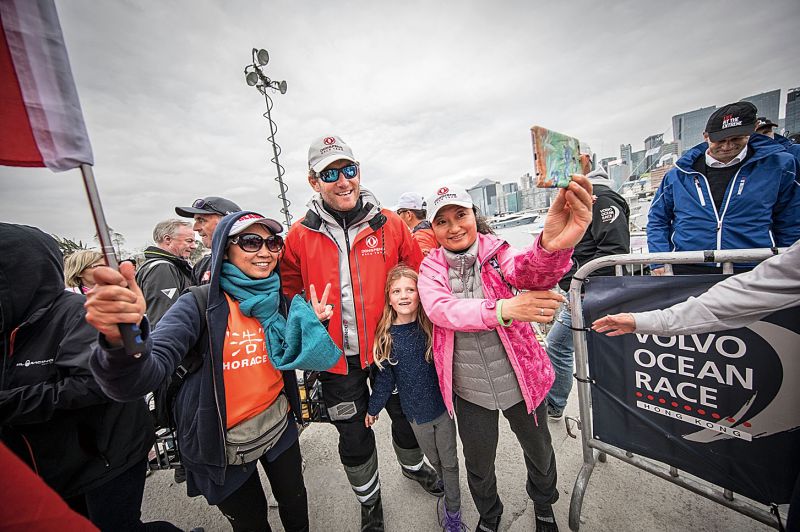
Our correspondent Viktoria Struts met with Charles Caudrelier during a stopover in Cape Town—right after the in-port race, which Dongfeng won brilliantly—and conducted an exclusive interview.
Which do you enjoy more—harbour races or offshore legs?
You experience them very differently. Offshore racing obviously involves a lot of physical hardship, but you also have time—time to assess the situation, adjust your tactics, and even take some pleasure in it: admire nature, feel emotions. Sometimes you love it, sometimes it drives you crazy—in short, there are many moments; it’s life. Harbour races may seem easier, but they’re not, because over a sprint distance you have to be maximally focused and show everything you can do, with hundreds of spectators watching. Short races are always tougher.

The Volvo Ocean Race motto is “Life at the Extreme”. Crews spend weeks at sea—climate changes, storms, crazy speeds, injuries, lack of sleep—yet you talk about enjoyment. What is hardest for you personally? And what do you like most?
Bad weather isn’t the biggest challenge. Sometimes, even if the wind is storm-force but steady, nothing extraordinary happens on board—yes, you’re soaked, yes, you’re pushing for maximum speed, but the situation is predictable: you stand your watch, you sleep… everything follows a routine. And then, on a clear, pleasant day, a front can suddenly hit, and it’s all hands on deck—no sleep for 24 hours. That’s what really drains you. Or the cold—there are times you freeze solid on watch, hands in gloves but fingers still numb; you go below and everything inside the boat is wet as well… On deck you’re at least busy and can keep warm, but when it’s time to rest, you lie down, stop moving, and get so cold you can’t fall asleep.
This regatta is the longest sporting competition in the world—that’s the main difficulty. For nine months we live in a hard racing mode, under constant pressure. The longer you’re in the race, the less energy and strength you have; your reactions change—what seemed like a small problem on the first leg can become a big one on the last. But it’s exactly these trials that make you stronger. When you’ve completed the Volvo Ocean Race, you realise you’ve become a different person. That realisation is probably the powerful psychological reward that makes sailors love this race so much.

After the finish, I suppose the first thing you do is collapse and sleep…
You wouldn’t believe it, but after a race it’s impossible to calm down right away—you’re still bursting with energy because you’re used to fighting, to constant load and adrenaline, and you can’t just switch that off. After the previous race it took me almost six months to settle down. And then, usually, some dynamic new project comes along, and it all starts again.
A sailing crew is often compared to an orchestra, where everyone plays their own part, but the whole must be perfectly in sync and intuitive. Do you have that level of understanding in the Dongfeng Race Team now?
When you reach that level, it means the team is truly strong. In the 2014–15 race our crew included very young Chinese sailors, and I’m happy to see how much they’ve progressed. In the last race, while helming, I was constantly watching them out of the corner of my eye—what they were doing, how they were doing it, and whether they were executing commands correctly. Now that supervision isn’t necessary. They’ve gained experience the hard way, in battle. I trust them. That’s perfection: no one needs someone standing over their shoulder, and there’s no need to constantly give orders—which also takes time, and seconds during manoeuvres are critical. In a good crew, everyone knows what to do, how, and when. That said, if you reach this level but don’t maintain that perfect “chemistry”, it disappears very quickly. You have to train together constantly, honing interaction. There is no finish line to perfection.

You began your career as a solo sailor, then moved into team racing. Yet in different interviews you often repeat the idea—quoting you—“I’m not a real leader because I don’t like giving people orders, telling them what to do." I always want to do everything myself.” At the same time, those who have raced with you describe you as a strong leader. How do these things fit together?
I think the main thing is to create the right spirit in the team so people enjoy and want to work together. The key task of a captain, a leader, is to select people who all genuinely want to win. I want the guys to take initiative, to anticipate each other’s actions, and to understand the helmsman’s line of thinking—in short, to feel that the result depends on each of them. In the end, if the team wins, it means the leader is good.
Dongfeng’s goals in the previous race were fairly modest: to win at least one leg. But in the end you finished third overall. Standing on the podium was an excellent result for a debut team from a country where sailing is still something of an exotic sport, and in China you became national heroes. After such success, expectations are obviously higher. Do you feel psychological pressure? Does it get in the way, or does that support help?
Every athlete knows this feeling: high expectations are always there. We talked about leadership—well, a good leader has to go through that psychological pressure himself and guide the team through it toward victory. The best approach is not to dwell on it but simply to do your job as well as possible. I don’t think about expectations at all; I try to give everything I have, and so does my team. Everything is in our hands.

Meanwhile, the organisers have announced plans to move from a three-year to a two-year cycle. Spectators will like it—we sit in front of our screens, follow the race as a kind of reality show; it’s exciting. But for the sailors it’s already an extreme test of endurance. Will they cope? What do you think about the new regulations?
Even now, with starts every three years, I can say it’s a challenge for all sailors and for their families. Being away from home for nine months is incompatible with a normal life. Among other proposed changes was the idea of shortening the race from nine to five months—that would be more convenient for us, for the audience, and for the media, who would find it easier to maintain interest in such a long-running event.

Volvo is a progressive company; it is constantly looking for new paths of development, both in the automotive business and in its sporting role as title sponsor of the world’s most extreme regatta. So the organisers’ desire to improve things, add something new, and reach new horizons is quite understandable. For example, there are proposals to include stopover ports in more countries than now. For team sponsors, that’s fantastic promotion—they’ll like it, and as a result more people will become involved in the event. I’m in favour of having more boats on the start line, more teams, and more countries—this will help promote the race itself and sailing as a whole. Take France: the Volvo Ocean Race isn’t that popular there because we have many world-class regattas of our own, and we often don’t pay much attention to events outside the country. But when the French yacht Groupama took part in the VOR, everyone was proud of it and followed the race closely. We have many top-level sailors in France, yet now several of us are racing with Dongfeng not for France, but for China. If the team were national, all of France would be cheering, and our media would cover the round-the-world race extensively. The Volvo Ocean Race is one of the world’s top sporting events, and when thinking about its future, we need to take these factors into account.
Good luck, Charles! Any final words for the readers of Yachting magazine?
I hope that one day I’ll see a Russian boat on the start line of the Volvo Ocean Race. Your country already has experience of participating, and you have strong maritime traditions. I’ve raced against Russians in various regattas—for example, in Shanghai in the SB20 class—and you’re excellent sailors. I’m sure you can put together a strong team. And then we’ll measure ourselves against each other in the round-the-world race!